Understanding Aerosol Smoke Alarm Testing Sprays
What Is a Pressurized Smoke Simulator Spray
Nearly 70% of residential fires in South Africa happen at night, yet many homes lack functioning alarms. A smoke detector gas tester solves this problem by verifying whether your unit responds to real combustion byproducts.
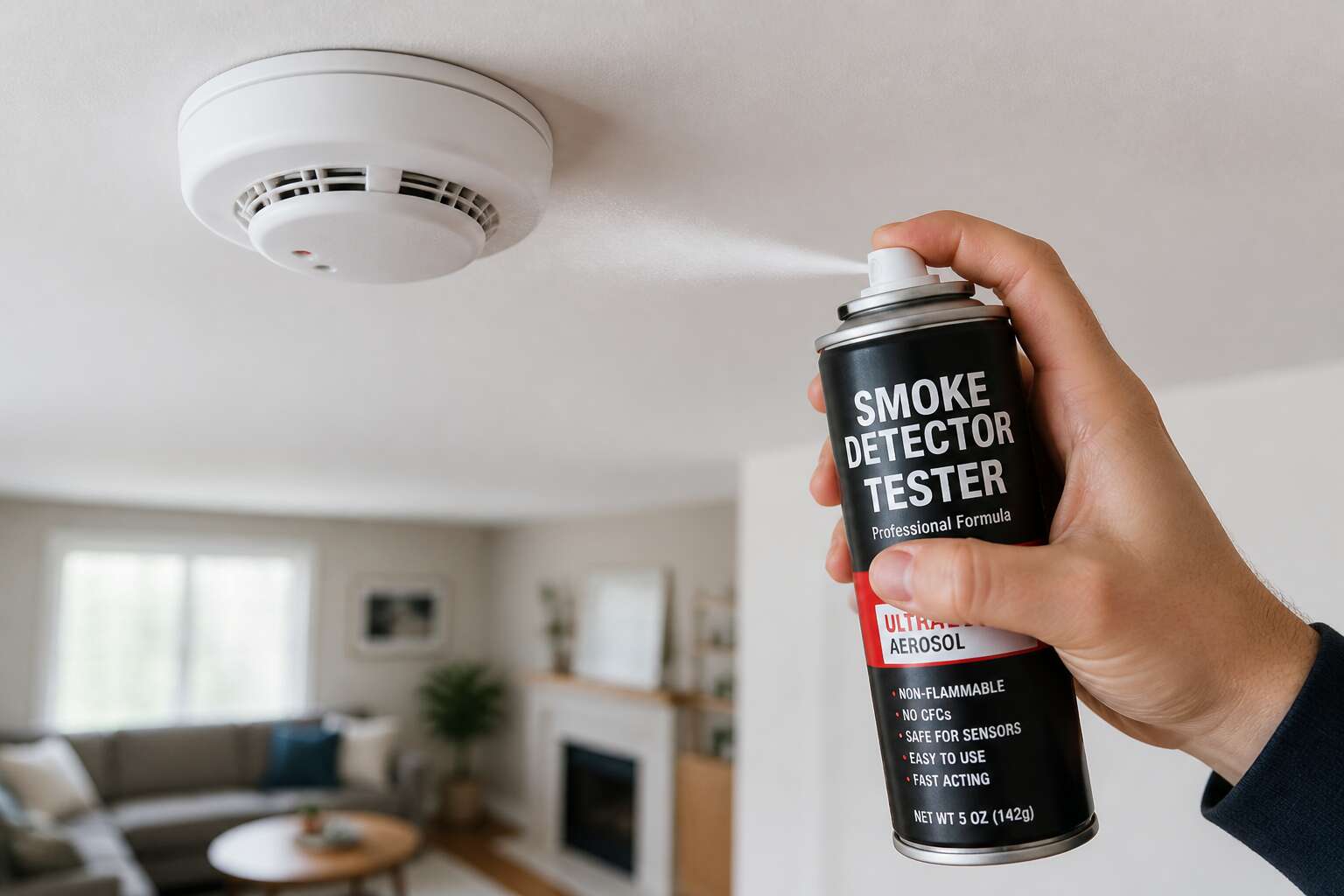
Aerosol smoke alarm testing sprays contain a calibrated mixture of synthetic smoke particles and propellant. When you spray, the pressurised canister releases a plume that mimics the optical density of genuine smoke. This allows the detector’s sensor to trigger the alarm, confirming its operational status.
Unlike a lit candle or actual smoke, the spray leaves no residue and avoids false alarms. The result is a reliable, repeatable test. Many technicians prefer a smoke detector gas tester for its precision and speed.
How Test Aerosols Replicate Smoke Particle Behavior
Fire research shows that smoke particles settle or cling to surfaces differently depending on their size. Aerosol sprays for alarm testing are engineered to mimic the exact particle diameter range that photoelectric and ionization sensors are designed to detect. When you use a smoke detector gas tester, the spray releases a fine mist that travels into the sensing chamber the same way real combustion byproducts would. The detector then responds within seconds, confirming that the optical path is clear and the electronics are functional.
One critical detail is the particle size distribution:
- Photoelectric detectors react best to larger particles, typically above 0.5 microns.
- Ionization detectors respond to smaller particles, below 0.1 microns.
- Most test aerosols blend multiple particle sizes to cover both technologies.
This replication is why a smoke detector gas tester outperforms a candle flame, which produces mostly heat and larger particles, or a simple puff of dust. The spray’s calibrated density triggers the alarm without leaving residue on the sensor over time.
Why Routine Alarm Verification Is Critical
The Role of Functional Detectors in Fire Safety Statistics
Nearly one in five smoke alarms fails to sound when it matters most. That statistic should unsettle anyone responsible for a building’s occupants. A detector that cannot sense smoke is a liability.
In my experience, routine alarm verification exposes the gap between installation and function. A smoke detector gas tester releases a controlled aerosol that mimics the optical properties of real combustion particles, confirming that the sensor, circuitry, and alarm horn operate as one system. Without this verification, dust ingress and component drift go unnoticed.
Functional detectors are the foundation of passive fire protection. They provide additional seconds for evacuation, and those seconds reduce injury rates. Verification checks:
- Sensor sensitivity across the detection chamber
- Alarm audibility at the required decibel level
- Response time under simulated smoke conditions
These checks make a theoretical safeguard measurable. In South Africa, fire safety regulations increasingly demand documented proof of testing. The smoke detector gas tester is no longer optional equipment; it provides that proof.
Compliance With NFPA and Local Fire Code Requirements
One failed inspection can halt a building’s occupancy. NFPA 72 prescribes testing intervals, and South African fire codes enforce these standards through documented evidence. A smoke detector gas tester provides that evidence. Without it, compliance rests on assumption.
Routine alarm verification confirms the detector responds to synthetic smoke within the required time frame. It also proves the horn reaches the mandated decibel level and the control panel receives the signal. Inspectors ask for this data. Building owners need it.
A typical verification covers:
- Sensor response to aerosol particles that match real smoke characteristics
- Alarm audibility at the required level
- Signal transmission to the fire alarm control panel
Each result is recorded. A smoke detector gas tester transforms regulatory requirements into verifiable facts.
Consequences of Non-Functional or Malfunctioning Alarms
Approximately 73% of fire fatalities in South African residential structures occur between 22:00 and 06:00, when occupants are asleep. A detector with a dead battery or clogged sensor chamber might as well be a plastic ceiling ornament. It will sit there silently while smoke accumulates, offering no warning until the heat itself becomes the alarm.
The typical failure sequence is not dramatic. A sensor drifts out of calibration. Dust accumulates on the optical chamber. The ionization element loses its sensitivity. The unit still shows a green LED, so everyone assumes it works. Then, during an actual emergency, the device produces only a weak chirp or nothing at all.
Consider the human factor during a real incident. When an alarm fails, occupants lose their only advance notice. They must rely on smell or the sound of crackling timber, which provides seconds instead of minutes. This changes the situation from an orderly evacuation to a panic response in thick, toxic smoke.
The consequences for building owners are equally severe. A malfunctioning alarm system can result in:
– Litigation from injured occupants or families of deceased victims
– Insurance claim denials due to a lack of maintenance evidence
– Legal liability for negligent property management
– Significant civil penalties from municipal authorities
– Permanent damage to business reputation and property value
The cost differential is stark. A single can of smoke detector gas tester costs less than a modest restaurant meal. A failed inspection, however, can lead to tenant displacement, legal fees, and months of operational downtime. The math has never been complicated, yet many property managers still gamble with human lives over a R150 aerosol can.
South African winters bring informal heating methods, overloaded electrical circuits, and paraffin stoves. These create unpredictable fire loads that demand fully functional detection systems. When a building is engulfed in flames, there is no time to run diagnostics. The only thing that matters is whether that alarm screamed loudly enough to wake a deep sleeper. If it did not, the fire department often finds the detector still mounted on the ceiling, covered in soot, with a battery that expired eighteen months prior. That silent witness is the most damning evidence in any post-fire investigation.
How Environmental Factors Degrade Sensor Sensitivity
Routine verification with a smoke detector gas tester is the only defense against silent sensor drift. Environmental factors attack detector components daily. Coastal humidity corrodes contact points in Cape Town. Highveld dust settles into optical chambers. Cooking aerosols and paraffin fumes leave a sticky film that alters how light scatters inside the sensing mechanism.
Thermal cycling creates another problem. Attic temperatures in Johannesburg can swing 30 degrees in a single day. That expansion and contraction stresses solder joints. A sensor that read correctly in January may be completely unreliable by June.
A routine pass with a smoke detector gas tester exposes these hidden failures. The spray introduces real smoke particles, forcing the unit to react. When the alarm sounds within the specified window, you have proof the entire detection chain works. Without that evidence, you are trusting a component that has been under constant assault since installation.
Failed sensors do not announce themselves. They simply wait.
Limitations of the Manual Test Button
The manual test button only checks the horn and battery, not the sensor. Pressing it confirms the alarm can make noise. It says nothing about whether the detector can see smoke.
A smoke detector gas tester forces real smoke particles into the chamber. This is the only way to confirm the sensor responds. The test button is a bypass. It completes an electrical circuit that has nothing to do with the sensing mechanism.
In South Africa, we mount detectors and forget them. The manual test creates a false picture of readiness. When the alarm sounds from the button, people assume the whole unit works. It does not.
Consider what the manual test cannot do:
- Verify the sensor’s response threshold
- Detect contamination in the smoke chamber
- Confirm the detector will react to an actual fire
Only a smoke detector gas tester can provide that evidence. Routine verification with a smoke detector gas tester is the difference between a working alarm and a non-functional one.
Step-by-Step Guide to Testing With Aerosol Sprays
Gathering the Right Equipment and Safety Gear
A smoke detector gas tester can fail you before it ever touches a ceiling if you skimp on preparation. I have watched technicians spray cans without checking their gear. That is exactly how an entire site ends up with unverified alarms.
Start by isolating the area. Confirm the alarm panel is armed for testing and the work space has adequate ventilation. Gather your ladder, safety glasses, gloves, and the detector’s datasheet. The aerosol propellant poses minimal risk at this distance, but skin contact should still be avoided.
Mount the ladder and aim the dispenser nozzle at the detector’s inlet vents. Hold it steady, then discharge a two second burst straight into the sensor chamber.
- Listen for the alarm response.
- Note the time before activation.
- Reset the unit.
- Move to the next detector.
Repeat this routine across every device in the loop, then log each result while the memory is fresh.
Preparing the Room and Avoiding False Triggers
A single misdirected burst from a smoke detector gas tester can cascade into false alarms across an entire floor. Air moves through corridors, vents, and open doorways, carrying the aerosol toward units you never intended to trigger. Before pressing the nozzle, close doors to adjacent rooms and silence the HVAC system. That alone prevents most cross-zone activations.
Consider the airflow around your immediate work space. Ceiling-mounted detectors often sit near return air grilles, so a wandering plume can easily confuse one sensor for another. Position the ladder, then check the direction of any residual draft. I found that a quick hand test near the inlet vents tells you more than guessing ever will!
Keep a clean sequence:
- Test one detector, reset the panel, wait for the zone to settle.
- Move to the next unit only after the system returns to normal.
This rhythm protects your test log while keeping the building quiet.
Correct Spray Distance, Duration, and Angle
Spraying a smoke detector gas tester is not about force. It is about precision. Hold the nozzle roughly one meter from the sensor face. This distance allows the aerosol to expand naturally, mimicking the way real smoke rises from a smouldering fire. Closer does not mean better! A concentrated jet can overwhelm the sensing chamber and create a false result.
Duration matters just as much. A short two second burst from the smoke detector gas tester usually triggers a response within thirty seconds. Longer sprays waste product and leave residue inside the detector, which will cause nuisance alarms later. The angle matters too. Direct the spray upward into the sensing chamber, because smoke enters a detector from the sides and top. Angling the canister straight on may bypass the sensor entirely.
Here is the sequence I follow:
1. Place the nozzle at arm’s length, angled upward.
2. Release a two second burst.
3. Wait for the alarm to sound.
4. Allow the residual aerosol to clear.
This approach keeps every test clean and repeatable.
Evaluating the Alarm Response and Sound Pattern
Once the aerosol clears, the real evaluation begins. The alarm should sound within thirty seconds of the spray. I always listen for the full cycle, not just the initial blast. A steady, loud tone indicates a healthy sensor. A weak or wavering sound means the detector is struggling. The smoke detector gas tester should produce a consistent response every time.
Compare the sound pattern to the manufacturer’s specifications. Most detectors emit a temporal pattern, three beeps followed by a pause. If the pattern is irregular, the internal horn may be failing. The reset behaviour also matters. Some units return to standby automatically, others need a manual press. Here is the sequence I use to evaluate the response:
- Time the interval from spray to alarm.
- Note the tone, volume, and pattern.
- Observe whether the alarm resets after the aerosol dissipates.
This method reveals more than a simple pass or fail. A delayed response or a distorted sound pattern points to contamination or component wear. A smoke detector gas tester that triggers a weak signal should prompt immediate replacement.
Clearing Residual Aerosol and Resetting the Detector
The aerosol leaves a microscopic film on the sensor chamber, and that residue can skew future readings. I always give the detector a full sixty seconds after the alarm stops before I touch anything. This waiting period allows the propellant to evaporate and the sensor to recover its baseline resistance. Rushing this step often produces a false negative on the next test.
Once the chamber clears, the reset procedure depends on the model. Some units return to standby automatically, while others need a manual press of the test button. I have found that a quick blast from a can of compressed air helps dislodge any lingering particles from the vents. The smoke detector gas tester leaves behind a visible trace on a white cloth, which tells me exactly how much residue the unit absorbed. A clean reset confirms the unit is ready for the next scheduled test.
Documenting Test Results for Maintenance Records
There is a quiet satisfaction in a job done properly, especially when that job involves the safety of a building. Testing with an aerosol can is straightforward, but the real discipline lies in the methodical approach. I hold the can upright, shake it for a full two seconds, and then place the nozzle into the detector’s vents at the recommended distance. A single, controlled spray is all it takes. I watch the unit, waiting for the siren to cut through the silence. If the alarm sounds within a few seconds, the sensor is working. If it does not, I know there is a problem that a second spray will not solve.
The precise parameters of the test matter more than most people realize. The spray angle, the duration of the burst, and the distance from the sensor all influence how the aerosol is drawn into the chamber. A short, steady press is better than a long, wavering one. Too much propellant can overwhelm the sensor, while too little might not register at all. I always note the time of day and the date in my log book after each test. This simple act turns a routine check into a documented history.
Documenting the results is where the true value of the exercise emerges. For maintenance records, I keep a simple log that tracks the performance of each unit over time.
– The date and time of the test.
– The specific unit identifier, like “Kitchen Ceiling” or “Hallway B.”
– The result, either a clear alarm response or a failure to trigger.
– The amount of aerosol used, if applicable.
These records show a pattern. A detector that struggles in winter, for instance, might have a temperature sensitivity issue. A unit that fails twice in a row needs immediate replacement. The smoke detector gas tester reveals the immediate condition, but the log book reveals the trend. I have seen many facilities where the difference between a close call and a catastrophe was a simple notebook entry that flagged a deteriorating sensor before it failed completely. The record is not just paperwork; it is a map of the building’s respiratory health. Each entry tells a story of vigilance, or the lack of it. When the inspector comes, they do not ask if you tested the alarms. They ask to see the proof. The proof is in the dates, the signatures, and the clear, unambiguous results. That sheet of paper is the quiet voice of a system that is ready to speak loudly when it matters most.
Selecting the Right Test Product for Your Detectors
Compatibility With Ionization and Photoelectric Sensors
Not every smoke detector gas tester matches both sensor types. Ionization alarms detect small particles from fast-flaming fires. Photoelectric alarms respond to larger particles from smouldering fires. An aerosol tuned for one type may not challenge the other.
Professional testers offer separate formulations for each sensor. Some combine both particle sizes in one canister. For mixed systems, this dual-range approach provides a more reliable field test.
I always check the particle size specification before spraying. The label tells you exactly what the gas tester replicates. Matching the aerosol to your installed units ensures the sensor responds to a realistic fire signal.
Comparing Refrigerant-Based vs Non-Flammable Formulas
The choice between refrigerant-based and non-flammable formulas carries more weight than most maintenance schedules admit. Refrigerant-based aerosols deliver a dense plume that mimics smouldering conditions with unsettling accuracy. Non-flammable blends rely on inert propellants that disperse faster and leave less residue on the sensor chamber.
I have seen facilities where the wrong formula caused chronic false negatives. The refrigerant option works well in cold warehouses where the plume must linger. The non-flammable version suits occupied offices where rapid dissipation prevents nuisance alarms. Storage temperatures affect both. Refrigerant formulas lose pressure below 10 degrees. Non-flammable canisters tolerate wider swings.
Consider these distinctions when selecting a smoke detector gas tester:
- Refrigerant-based: heavier plume, longer hang time, more residue
- Non-flammable: lighter dispersal, cleaner chamber, quicker clear
My own kit favours non-flammable for general use, with a refrigerant canister reserved for stubborn photoelectric units. The smoke detector gas tester you pick will either confirm your system’s vigilance or expose its silence at the worst moment!
Portfolio Options: Single-Use Cans vs Refillable Units
Choosing between single-use cans and refillable units changes how your maintenance team approaches annual detector checks. Single-use canisters offer portability and no calibration concerns, but they create ongoing waste and per-test costs that accumulate across a large portfolio. Refillable units require an initial investment in a compatible smoke detector gas tester and a separate aerosol supply, yet they allow consistent pressure output and reduced environmental impact.
Consider the logistics of your sites:
– Single-use cans suit small buildings with sporadic testing schedules
– Refillable units serve sprawling facilities where technicians test dozens of detectors weekly
– Bulk aerosol refills lower the cost per test significantly
I have watched teams waste hours tracking down spent canisters mid-inspection. A refillable system removes that friction, though it demands disciplined storage and handling. A reliable smoke detector gas tester portfolio should match the format to your operational rhythm.
Evaluating Brand Reliability and Industry Certifications
Selection hinges on verification, not habit. A smoke detector gas tester from an obscure supplier might pass the first spray, but repeatability matters more than a single reaction. Inspectors need the same response from every canister in the portfolio. Independent testing laboratories publish detailed results; seek those documents before choosing a smoke detector gas tester.
Certification marks indicate that a product meets recognised standards, yet not all marks carry equal weight in South Africa. Confirm that the certificate was issued by an accredited body, and check the expiry date on the certification. Some products lose their listed status when formulations change without re-testing.
- Review the certificate number against the issuing body’s database
- Verify the aerosol’s shelf life and storage temperature limits
- Match the test product to the detector models at each site
A certified product removes ambiguity from maintenance reports. An uncertified alternative introduces doubt into the records your team signs.
Maintenance, Storage, and Frequency Guidelines
Recommended Testing Intervals for Residential and Commercial Settings
They say a fire doubles in size every sixty seconds. In the time it takes to brew a pot of coffee, a quiet smoulder can become an inferno. Yet, we often trust our alarms without a second thought, assuming they will cry out when the smoke thickens. The truth is harsher. Dust, humidity, and the slow creep of time render sensors blind. A smoke detector gas tester is the only honest method to confirm your device still sees what you cannot.
Storage of your tester demands a cool, dry cabinet, away from direct sunlight. Extreme heat warps the canister’s internal pressure, altering the spray’s particle size. Shake the canister before each use, and wipe the nozzle clean after every test to prevent propellant residue from clogging the actuator. A neglected nozzle delivers a weak plume, which leads to a false sense of security.
Battery preservation is paramount. Remove the tester from any vehicle or toolbag during winter months, as temperature swings cause condensation inside the valve. The chemicals inside a smoke detector gas tester are sensitive to moisture, which can degrade the aerosol’s ability to mimic real combustion particles. Treat the canister like a fine instrument, not a disposable commodity.
Frequency guidelines differ sharply between environments. For a private home, a functional test each month is sufficient, paired with a more thorough sensitivity check every six months. However, commercial kitchens, warehouses, and industrial sites demand weekly checks due to airborne grease and particulate matter that coat sensors rapidly.
– Residential: Monthly spray test, bi-annual visual inspection.
– Commercial: Weekly spray test, quarterly internal cleaning.
– High-risk zones like boiler rooms or paint shops: Daily visual checks and weekly aerosol tests.
The intervals are not arbitrary. They are derived from the operational failure curves of photoelectric and ionization sensors. While a manual test button only verifies the horn, a smoke detector gas tester validates the sensing chamber. In a bustling hotel corridor or a quiet suburban bedroom, the required vigilance diverges, but the consequence of neglect remains identical. Keep a logbook nearby. Mark the date, the result, and the canister’s batch number. This record is not bureaucratic theatre; it is the only proof your detector was alive when it mattered. Calibrate your routine to the rhythm of your building, or the silence of a failed alarm will be the last thing you hear.
Proper Storage Conditions to Maximize Canister Shelf Life
Think of the canister as a temperamental guest. It demands a specific environment to perform its single, vital trick. A smoke detector gas tester left baking on a windowsill in Durban or freezing in a Johannesburg storeroom will not deliver a reliable plume when you need it most. The propellant and the simulated smoke compound are a delicate emulsion, and temperature extremes break that bond. The result is a spray that falls short of the sensor, a test that means nothing. Store the unit upright, in a stable climate, away from direct sunlight and any source of heat. Think of it as a fine wine, but with a far more serious job to do.
The nozzle is the instrument’s mouth, and a clogged mouth speaks in whispers. After each use, wipe the actuator tip with a clean, dry cloth. A residue of propellant can dry into a film that disrupts the aerosol’s path. A weakened spray pattern, even by a small degree, can place your smoke detector gas tester outside the detector’s reach. Also, be mindful of your regional weather. In coastal areas with high humidity, condensation can form inside the valve mechanism and corrode it. In the Highveld, the dry air can cause the rubber seals to perish. Check for these signs of wear each time you pick the canister up.
The frequency of testing is a conversation between you and your building’s risk profile. For most homes in Cape Town, a competent monthly check is the bare minimum. But the guidelines for commercial properties are stricter for a reason. A kitchen in Sandton, with its airborne grease, or a workshop with fine dust particles, will degrade sensor performance in days, not months. Your maintenance schedule should reflect the air your detectors breathe.
– Store the smoke detector gas tester in a cool, dry place, away from electrical panels or direct sunlight.
– Do not store near heating vents or air conditioning units.
– Keep the canister upright at all times to prevent the valve from becoming blocked.
When you do conduct a test, treat it as a protocol, not a ritual. Ensure the environment is free of actual smoke or steam before you begin, to avoid a false positive that undermines your logbook. Remember, a thorough record of your testing schedule is not just for the inspector’s clipboard. It is a maintenance history that tells you when your sensor is drifting before it fails completely. This is the quiet diligence that prevents a catastrophic oversight.
Signs That Your Tester Spray Is Expired or Depressurized
An expired smoke detector gas tester hides its failure. The canister looks identical to a fresh unit. The propellant may have leaked past the valve, or the compound has separated. You notice when you press the actuator and receive a weak puff instead of a deliberate plume.
Maintenance begins with listening. Your smoke detector gas tester should hiss steadily, not sputter. Weigh the canister. A depressurized unit feels lighter than the empty weight on the label. Shake it. A sloshing sound means the contents have separated.
Trust these signs over the calendar!
- The spray arc wavers or drips.
- The nozzle threads show crystallised residue.
- The canister has exceeded its expiry date.
Frequency of use changes the canister’s lifespan. A unit that sees weekly tests in a commercial kitchen will depressurise faster than a monthly household canister. Track your usage; an empty canister holds no pressure, and a partially empty one delivers a weak plume.
Cleaning Detector Vents and Sensors After Testing
After each test with a smoke detector gas tester, the detector’s vents and sensor chamber need attention. The aerosol plume leaves a fine residue. A soft brush or compressed air clears the openings without damaging the internal components. For photoelectric sensors, dust buildup scatters light and causes false readings. Ionization chambers respond poorly to oily films.
Frequency depends on the environment. A detector in a workshop with sawdust needs monthly cleaning. One in a clean office needs attention every quarter. Coastal humidity and Highveld dust accelerate the process. The smoke detector gas tester itself should be wiped after use to prevent nozzle blockage. A blocked nozzle affects the spray pattern and compromises the next test.
Consider these guidelines:
- Clean vents with a dry microfiber cloth
- Use compressed air from a distance of 30 cm
- Never use water or solvent on the sensor chamber
Storage of the detector is straightforward. I keep it free from paint, dust, and humidity. A vacuum cleaner with a soft brush attachment handles stubborn particles.
Coordinating Professional Inspections With In-House Testing
Relying solely on annual professional inspections leaves gaps. In-house testing with a smoke detector gas tester catches drift between visits. The frequency of both depends on the building risk profile and local by-laws. Pairing monthly visual checks with quarterly functional tests works for most commercial spaces.
- Check the tester canister pressure before every use.
- Replace the unit after the certified number of discharges.
- Rotate stock so no canister sits past its expiry date.
Store the smoke detector gas tester upright in a cool, dry place. Extreme heat deforms the valve. Humidity corrodes the nozzle. Always coordinate your records with the professional inspector’s report. That way, no test is duplicated and no sensor is neglected.
Troubleshooting Unresponsive or Oversensitive Alarms
Interpreting Weak, Delayed, or Absent Alarm Responses
A smoke detector that greets a fresh can of test aerosol with nothing but silence is either having a quiet day or quietly failing. The difference is not a matter of opinion. A smoke detector gas tester exists to make that distinction obvious, yet many facility managers still guess at what the results mean. Weak beeps, delayed responses, and complete indifference each carry a separate message.
A weak response usually points to a sensor that has lost sensitivity over time. Dust film, insect ingress, and humidity all contribute, but the symptom remains the same. The alarm acknowledges the aerosol but with less urgency than expected. A delayed response is more troubling. It suggests smoke particles are reaching the chamber slowly, meaning the detector could miss the early stages of a real fire. Here, the aerosol’s behaviour becomes a diagnostic tool rather than a simple pass or fail.
Oversensitive detectors present a different puzzle. They sound off when a candle is lit three rooms away, or when the kettle boils. Common culprits include:
- Residual aerosol from previous tests settling on the sensor
- Airborne cooking grease or steam that mimics smoke particle profiles
- Voltage fluctuations from the electrical grid, which are not rare in South Africa
- Accumulated dust scattering the light beam inside photoelectric chambers
A smoke detector gas tester helps you determine whether that responsiveness is calibrated or misplaced.
If the detector answers a short, controlled spray with an immediate full alarm, the sensor is healthy. If it responds after a long pause, or not at all, the internal components may be degrading. Absent responses deserve the most scrutiny. A detector that ignores a direct aerosol burst is not being stubborn. The sensing chamber may be clogged, the electronics faulty, or the device may have reached the end of its service life. The silence during testing matches the silence that would follow a real fire. Interpreting these signals correctly is the entire point of using a smoke detector gas tester.
Handling Nuisance Triggers and Sensitive Calibration Issues
An oversensitive alarm is a different kind of failure. It interrupts daily work with false calls, and every false call teaches people to ignore the real one. That erosion of trust is dangerous. The smoke detector gas tester separates nuisance triggers from genuine sensitivity. If a short spray sets off the alarm instantly, the sensor is calibrated correctly. If the alarm fires before the aerosol reaches the chamber, or reacts to kettle steam, the problem is placement or chamber contamination.
Common nuisance triggers include:
– Steam from industrial washing or food preparation areas
– Vehicle exhaust near loading bays
– Aerosol cleaning products used nearby
– Air conditioning drafts pushing cooking odours past the sensor
A smoke detector gas tester provides a controlled reference. You compare the alarm’s reaction to that reference, not to ambient conditions. Unresponsive detectors need cleaning or replacement. Oversensitive ones need relocation or a sensitivity check. Both outcomes are decisions, not guesses, and the tester makes those decisions possible.
When to Replace Detector Units vs Recalibrating Sensors
A detector that stays silent after a direct blast from a smoke detector gas tester leaves two possibilities: contamination or a dead sensor. Cleaning the vents solves the first. If the unit still refuses to respond after cleaning, replacement is the honest choice. Recalibrating a sensor that cannot detect a known aerosol wastes time and budget.
Oversensitive alarms are the opposite puzzle. A unit that screams before the spray arrives is usually mispositioned, not miscalibrated. Look at the location first. Is it near a kettle, a loading bay, or an air conditioning vent? Relocation cures those false triggers. Recalibration only suppresses the symptom.
- Contamination shows improvement after cleaning; a dead sensor stays mute.
- A false trigger before spray arrival points to placement, not calibration.
- An erratic response after both fixes means the sensor’s age has caught up.
Every test with the smoke detector gas tester forces the issue. Units older than ten years should be replaced rather than recalibrated. That standard matters in South African facilities, where heat and dust shorten sensor life.
Dealing With Low-Battery Warnings During Test Procedures
A weak battery mimics a dead sensor more often than technicians admit. In my experience, a detector that responds weakly to a smoke detector gas tester blast is low on power, not dying from contamination. South African heat accelerates battery drain. A unit that passed last quarter can fail silently today. When troubleshooting unresponsive or oversensitive alarms, check the power source first. Remove the battery, inspect terminals for corrosion, and fit a fresh unit. Then rerun the test. If the response normalises, the sensor was never at fault. If the alarm still misbehaves, the problem runs deeper.
Dealing with low-battery warnings during test procedures demands a clear sequence:
- Replace the battery before blaming the sensor.
- Re-test after five minutes, not immediately.
- Note whether the chirp stops or persists.
The smoke detector gas tester only reveals what the detector allows. Power the unit, and the reading means something. Run it with a weak battery, and you interpret false failures as sensor faults.


0 Comments