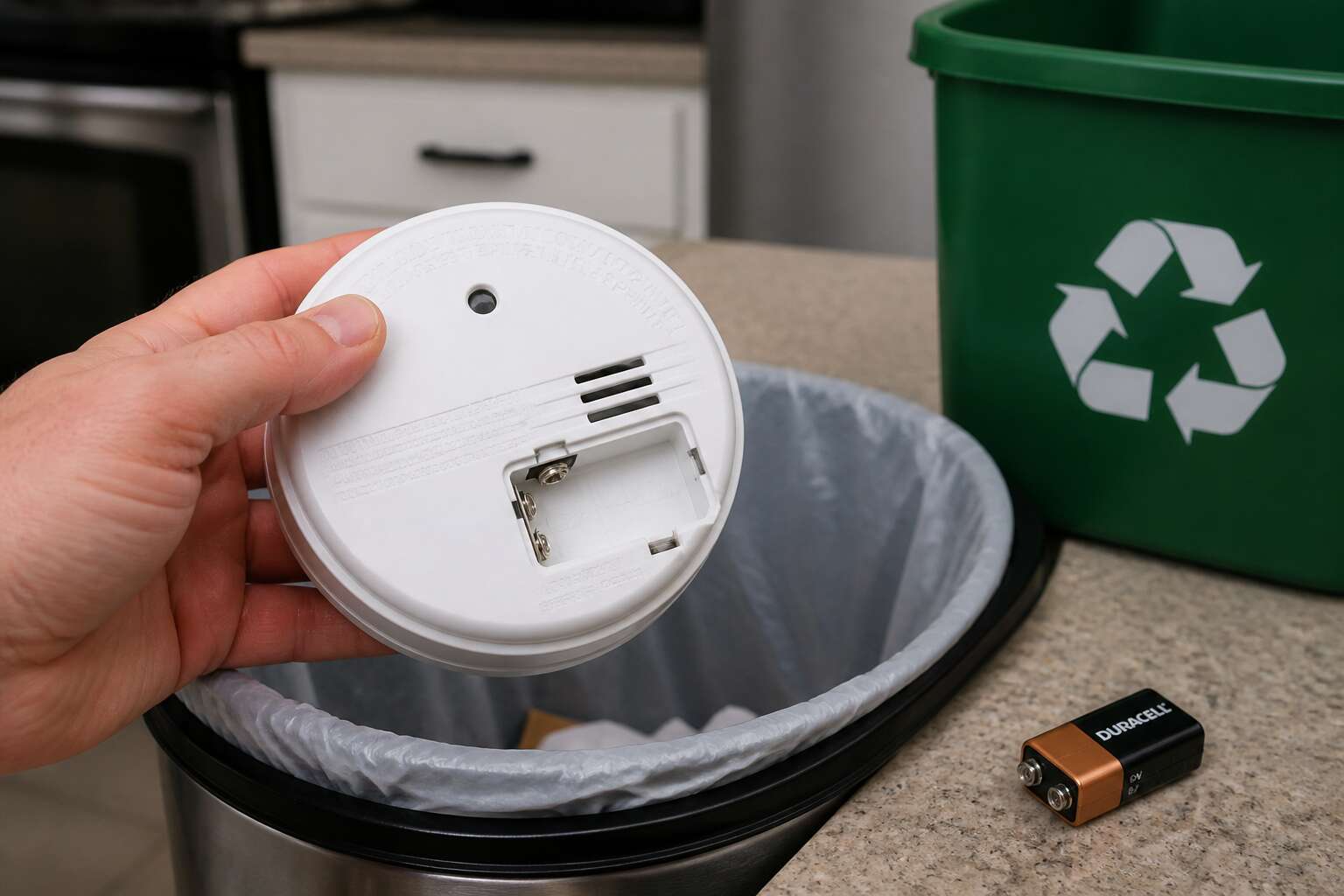
Understanding Smoke Detector Disposal Regulations
Federal Guidelines for Household Hazardous Waste
When homeowners ask can smoke detectors be thrown in the trash, the answer is rarely simple. Ionisation models contain americium 241, a radioactive isotope that persists after the casing breaks. In South Africa, the National Environmental Management: Waste Act classifies these devices as hazardous waste, so general rubbish bins are legally inappropriate.
Provincial regulations vary. I rarely see anyone read the back label before disposal. Some municipalities accept devices at hazardous waste drop off points, others demand manufacturer return. Federal guidelines, interpreted locally, steer away from landfill disposal. The danger lies in accumulated radioactive elements reaching soil and water.
- Ionisation symbols appear on the back label
- Municipal drop off schedules differ by province
Pitching a detector into the bin clears your countertop, but that act has consequences for others. Landfill workers and informal recyclers come into contact with what you discarded.
State and Local Variations in Disposal Laws
The real challenge begins at the municipal level. A single device can face three different outcomes depending on where you live. In Gauteng, some metros classify detectors as e-waste and send them to certified recyclers. KwaZulu-Natal municipalities often prefer household hazardous waste drop off sites, though their collection schedules shift from month to month.
Local by-laws address what national law leaves open. A handful of towns require manufacturer return programmes. Others accept detectors only during annual hazardous waste events. I have stood at the bin myself, device in hand, wondering which category applies to me.
- Some municipalities file detectors under e-waste, others under hazardous waste
- Drop off frequency varies, with some sites running monthly and others quarterly
These variations mean the answer to can smoke detectors be thrown in the trash depends on your postal code, not just your country.
Identifying Your Smoke Detector Type (Ionization vs. Photoelectric)
The real puzzle lies in identifying what your detector actually is. I spent ten minutes staring at the back of mine, searching for the manufacturer’s stamp. This identification matters because the question of can smoke detectors be thrown in the trash depends on it.
You have two possibilities. An ionization detector holds a tiny radioactive foil, usually Americium-241. A photoelectric detector, however, uses an internal light beam and contains nothing radioactive.
How do you tell them apart?
- Look for the radiation trefoil symbol printed on the casing.
- Search for the words ‘ionization’ or ‘photoelectric’ on the label.
- Check the manufacturer’s website using the model number.
In my experience, the ionization models are the ones that cause hesitation at the bin. Knowing which type you own clarifies your responsibility before you even consider local schedules. Once identified, the question of can smoke detectors be thrown in the trash gains a definitive answer.
Why Smoke Detectors Are Not Ordinary Trash
Here’s a grim thought: your smoke detector may contain Americium-241, a radioactive isotope with a half-life of 432 years. That speck will outlive your house, your municipality, and the landfill itself. When residents ask can smoke detectors be thrown in the trash, the answer is that your bin is not equipped for radioactive disposal.
Garbage trucks handle decaying vegetables, not radiation sources. Dumping an ionization detector into ordinary waste buries a tiny atomic emitter in soil for centuries. Which is why disposal regulations treat these devices differently and why municipalities collect them as hazardous waste instead.
Inside your detector:
- A button battery that leaks caustic chemicals.
- A plastic shell that becomes microplastics.
- A radioactive foil that never degrades.
None of that belongs in a daily collection round. Municipal collectors tend to respond to the question of can smoke detectors be thrown in the trash with a firm refusal.
Manufacturer Instructions and Warranty Considerations
Manufacturer instructions often include a dedicated section on disposing of your smoke detector after its usable life. That manual sheet lays out accepted methods for your specific model, which takes precedence over generic advice.
. Meanwhile, warranty considerations shape how you handle the device. If you force open the casing or damage the circuit board to extract a part, you might void the warranty before the warranty period ends. In South Africa, municipal regulations are not uniform, so you must consult your local bylaw office. When tenants ask can smoke detectors be thrown in the trash, landlords should direct them to those official channels instead. The answer to that question is rarely yes, given these layers of rules. Follow these steps to stay compliant:
1. Locate the model number and check the manufacturer’s website for disposal guidance.
2. Verify your municipality’s hazardous waste collection schedule.
3. Document any disposal actions for warranty records.
Environmental Impact of Improper Disposal
Radioactive Materials in Ionization Detectors
One startling fact: a single ionization smoke detector contains about one microcurie of americium 241, a radioactive element with a half life of 432 years. Tossing these devices into a landfill is not a victimless act. The long term consequences of improper disposal are quietly severe for South African environments.
When the casing corrodes, the radioactive source can leach into the surrounding soil and groundwater. This contamination doesn’t break down. It persists in the ecosystem, posing a risk to aquatic life and potentially entering the food chain. Considering whether can smoke detectors be thrown in the trash is a serious question when the answer involves introducing a permanent hazard to a local water table. The compact design that makes the detector functional also makes it a concentrated source of potential harm once its integrity is compromised.
– Soil contamination that inhibits plant growth and microbial activity.
– Water pollution that affects both human settlements and wildlife.
– A cleanup process that is costly and technically demanding for municipal authorities.
The physical danger is minimal during handling, but the material’s insolubility means it remains dangerous for centuries. Landfill liners are not designed for perpetual vigilance. They fail, and the slow decay of the device’s casing accelerates that failure. Disposing of this device as ordinary municipal waste shifts the burden of radioactive stewardship from the owner to the community and the unsuspecting generations that follow. The question, “can smoke detectors be thrown in the trash,” carries a heavier weight when the full life cycle of americium is considered.
Heavy Metals and Circuit Board Toxins
The circuit board inside a smoke detector is a dense repository of heavy metals. Lead solder secures the components. Cadmium appears in resistors. Brominated flame retardants coat the plastic casing. When rain and microbial activity attack the device in a South African landfill, these toxins mobilize into the surrounding leachate.
The question of can smoke detectors be thrown in the trash becomes more uncomfortable once you understand the chain of harm. Heavy metals do not decompose. They accumulate. Lead disrupts neurological function in children. Cadmium damages kidney tissue over decades. Brominated compounds resist breakdown and travel far beyond the original waste site.
Landfill liners fail. They are engineered for certain loads, not perpetual containment. The leachate moves downward, carrying toxic loads into groundwater or adjacent soils. Municipal authorities then face expensive remediation or permanent monitoring. The device’s small size belies the concentrated toxicity it releases once crushed and buried.
Landfill Leachate and Soil Contamination
When that plastic casing finally cracks under the pressure of a thousand tons of compacted waste, the real story begins. The question of can smoke detectors be thrown in the trash often ends with a shrug, but the landfill becomes the final custodian of your decision. Rainwater filters down through the layers, creating a potent brew known as leachate. This dark liquid is the messenger, carrying the burden of the device’s internal chemistry into the soil below.
The ground acts as a silent sponge, but it has its limits. Clay layers can slow the migration, yet they cannot stop it entirely. Over the decades, the contaminants seep deeper, turning a simple disposal error into a long-term geological problem. The soil structure changes, and the natural filtration process is overwhelmed. It is a slow, quiet pollution that is expensive to reverse and difficult to track.
Your single device might seem insignificant, but consider the accumulation from an entire neighbourhood. The pollutants that escape the waste stream include:
– Antimony trioxide, used as a flame retardant, which can irritate skin and lungs.
– Polyvinyl chloride (PVC) in the wiring, which releases toxic dioxins when burned.
– Trace amounts of gold and copper, which, while valuable, are locked in a toxic sludge that makes recovery uneconomical.
The heavy rain in coastal regions of South Africa accelerates this process, pushing the contamination deeper and wider. As the leachate plume spreads, it can eventually reach groundwater sources, which are often used for agriculture. This is where the cycle of harm truly closes, moving from the landfill into the food chain. The question of can smoke detectors be thrown in the trash is no longer about convenience, but about the legacy of the soil we leave behind.
Air Quality Concerns from Incineration
When a smoke detector meets a flame, whether in a backyard fire or a municipal incinerator, the question of can smoke detectors be thrown in the trash takes on a new dimension. The plastic casing does not simply melt. It combusts.
Burning releases toxic compounds that travel far beyond the original fire. The circuit board contains brominated flame retardants. When heated, these transform into polybrominated dibenzofurans, a class of chemicals with no safe exposure level.
The smoke plume carries:
- Particles that lodge deep in lung tissue
- Heavy metal aerosols that settle on soil and rooftops
- Dioxins that persist for generations
In South Africa, where informal waste burning occurs in many areas, these emissions affect nearby communities directly. The air becomes the vector, turning a disposal decision into a public health matter.
Impact on Waste Management Workers
The quiet beep of a smoke detector is designed to be a nuisance, a sharp prod that saves lives. But when that same device ends up in a municipal waste stream, the nuisance transforms into a hazard for the people who handle our rubbish. This is where the practical answer to can smoke detectors be thrown in the trash gets complicated for those on the front lines.
Waste management workers are the first line of defense, yet they are often the most exposed. When a detector is crushed in the back of a collection truck or under the compactor blade at a transfer station, the plastic shatters. Unfortunately, the interior components, often containing a small pellet of Americium-241 to generate ionizing radiation, are not designed to be crushed. This creates a specific set of risks for these employees:
Inhalation Risk: The radioactive material is bonded to a gold foil, but physical impact can dislodge microscopic particles, creating a dust that is easily inhaled.
Cuts and Abrasions: Sharp shards of broken circuit boards and plastic casings are a common cause of injuries, which then become entry points for contaminants.
Systemic Contamination: If a detector is broken and the source is exposed, it can contaminate the immediate area, requiring specialized cleanup and putting the entire crew at risk.
The question of can smoke detectors be thrown in the trash is often answered with a shrug by a homeowner, but for the sanitation department, it is a question of occupational safety. They are the ones who have to touch the waste, sort the recyclables, and manage the residue. They are the ones who face the consequences of a national mindset that treats “throw it away” as a magical disappearance. The bin is not a portal; it is a collection point where hazards are concentrated, and the people who manage that concentration deserve better than our laziness.
Ecosystem Damage from Unregulated Dumping
When a detector is tossed into a gully or a roadside dump, the question of can smoke detectors be thrown in the trash becomes an ecological one. The plastic casing weathers under the Highveld sun, cracking into fragments that enter stormwater drains. Rain carries debris into rivers like the Vaal or the Umgeni, where fish ingest fine particulates.
The Americium source, though small, can leach into sediment. Over time, this contaminates grazing land near informal dumping sites. Consider what happens when a detector ends up in a backyard burn barrel or a veld fire:
- the radioactive foil oxidises and disperses as ash
- heavy metals from the circuit board settle into the soil
- plastic residue enters the food chain through livestock
These unregulated sites bypass every safeguard. Can smoke detectors be thrown in the trash? In an unregulated sense, they often are, but the ecosystem pays the cost.
Safe Disposal Methods for Smoke Detectors
Battery Removal and Separate Disposal
It is a quiet, deliberate act that matters more than most people realize. Removing the battery from a smoke detector is the first step, but it is only a preliminary one. The detector itself, the plastic casing, the circuit board, and any internal components still hold their own hazards. You cannot simply toss the whole unit aside after the battery is out.
The process of battery removal and separate disposal is straightforward but requires vigilance. For most detectors, you twist the unit counterclockwise to detach it from its mounting plate. A firm press on the locking tab or a simple pull will reveal the battery compartment. Remove every battery, including backup units, and place them in a small plastic bag. Alkaline batteries can often go in your regular waste bin in South Africa, but lithium batteries demand a trip to a dedicated recycling point. The detector body itself should not join the household trash can.
Consider the steps involved in this careful separation:
- Twist or unscrew the detector from its ceiling mount.
- Extract all batteries, checking for hidden backup cells.
- Place batteries in a sealed bag for proper disposal.
- Store the detector body separately, away from children and pets.
Once the batteries are out, the question persists: can smoke detectors be thrown in the trash? The answer remains a firm no. The plastic shell and electronics require a different path. Many municipalities in South Africa have specific e-waste drop off points. These facilities handle the dismantling and recycling of the components, keeping the heavy metals and plastics out of the ground. Treating the detector as a single waste item undoes all the good you achieved by removing the battery. It is a small chore, but it is the right one.
Sealing Detectors Before Disposal
So, can smoke detectors be thrown in the trash? The short answer is no, but you might need to do a little work first. It all depends on the type of detector you have and the rules in your area. The reason isn’t just because it’s a hard plastic object that will sit in a landfill for centuries. The real issue is what is inside the device.
Most modern smoke detectors fall into two categories. The first is the ionization type, which contains a tiny amount of radioactive Americium-241. While this amount is minuscule and shielded inside the unit, it is still a radioactive material. The second type is the photoelectric detector, which uses a light beam and doesn’t contain radiation, but still carries a heavy circuit board and often a lithium battery.
Before you even think about where to toss the outer shell, you have to separate the components. The battery must always be removed. Most detectors will have a sealed battery unit that you cannot replace, but you can still detach the entire assembly from the plastic base. You might need to twist the detector counterclockwise to pop it off its mounting plate. Some units have a simple clip you can press. Once you have the power source out, you have to decide what to do with the rest.
You cannot simply place the whole device in your household bin. In many jurisdictions, treating the detector as a single waste item undoes the careful work of keeping heavy metals out of the groundwater. Municipalities often require residents to bring these to a dedicated e-waste drop-off point. These facilities know how to dismantle the unit and recycle the plastics and metals safely. Some areas even classify smoke detectors as hazardous household waste, meaning they have to go to a specific collection event rather than a curb-side bin.
The process of removing the battery and separating the disposal is straightforward but requires vigilance. You should never just pull the unit off the ceiling and toss it in a plastic bag for the regular trash. The detector body itself should not join your general waste. Alkaline batteries can often go in your regular waste in South Africa, but lithium batteries demand a trip to a dedicated recycling point. The safe path is to check your local waste management website for the specific drop-off instructions for e-waste.
You might think that if you remove the radioactive source, the plastic shell is harmless. However, the circuit board and the wiring inside contain trace amounts of other heavy metals. As the plastic breaks down in a landfill, these elements can leach into the soil. It’s a small chore, but it is the right one. So, while the product itself is meant to protect you from fire, its disposal requires a little bit of environmental protection of its own.
Household Hazardous Waste Collection Events
Municipal household hazardous waste collection events offer a definitive answer to the question can smoke detectors be thrown in the trash. These gatherings accept devices that regular waste systems reject. Attendance is voluntary but essential. Organisers announce schedules through local portals and community boards.
The operations run with military precision. Workers sort detectors by model and age. They perform a preliminary scan for physical damage. The internal components then move through a staged process:
1. Ionization units have their americium foils extracted and logged.
2. Photoelectric sensors are crushed to recover rare earth magnets.
3. Circuit boards are packed for precious metal recovery.
Each step demands certification. The resulting waste fractions travel to licensed facilities for treatment or containment. In South Africa, these events are the primary route for responsible disposal. So can smoke detectors be thrown in the trash? Only the outer shell after thorough decontamination, and even then, not curb side.
Mail-Back Programs from Manufacturers
Some manufacturers have quietly solved the disposal riddle. Their mail-back programs accept old detectors straight from your postbox. You request a prepaid envelope, seal the device, and send it off. The factory handles everything else. This matters because the answer to can smoke detectors be thrown in the trash is still no for most units. Ionization models contain radioactive foil. Even photoelectric versions carry circuit boards laden with heavy metals.
- First Alert accepts ionization and photoelectric models
- Kidde runs a similar scheme for South African customers
- Ei Electronics offers prepaid returns through select retailers
These programs strip the units down to their raw materials. Nothing reaches a landfill. The cost sits with the producer, not the homeowner. So when the next replacement cycle comes around, check the packaging for a return address!
Municipal Drop-Off Locations
Your local municipality might be the most useful stop you never considered. Many South African cities operate dedicated drop-off points for hazardous household items. These are staffed facilities designed to handle the awkward stuff that should never meet a landfill.
Before you visit, call ahead. Some locations only accept detectors on specific days. Others require you to fill out a small form. Still, it beats leaving a radioactive foil sandwich in your wheelie bin. The answer to can smoke detectors be thrown in the trash remains a firm no, but a municipal drop-off makes the correct path far easier.
- Check your city’s waste management website for approved sites
- Keep the detector in its original packaging or a sealed bag
- Ask about maximum quantities for household drop-offs
Bring identification if your municipality tracks hazardous waste intake. The staff take the unit from there, and you walk away with a clear conscience and zero risk of contaminating groundwater.
Special Considerations for Hardwired Detectors
Many South Africans wonder if smoke detectors can be thrown in the trash. The short answer is no. These devices often contain small amounts of radioactive material, particularly in ionization models. The circuit boards also hold heavy metals. Regular household waste collection is not designed to handle such items. Instead, remove the battery first. Then locate your municipal hazardous waste drop off. Many cities in South Africa host these points on specific days. Some hardware stores offer take back programs. Check the manufacturer’s website for instructions. Sealing the detector in a plastic bag adds safety. Never place it in a recycling bin. Proper disposal protects waste workers and prevents soil contamination.
Recycling Options for Smoke Detectors
Recycling Programs for Electronic Waste
Yes, the short answer is often “maybe,” but the responsible answer is almost always “no.” You see, while many municipalities technically permit it, tossing a smoke detector into your everyday bin is a gamble with long-term consequences that far outweigh the convenience. The specific type of unit you own is the deciding factor here, and understanding the distinction is crucial for making an informed choice.
For older ionization models, which contain a minute amount of radioactive americium-241, the rules are stricter. Simply chucking these into a landfill means that hazardous material is buried and could potentially leach into groundwater over time. Photoelectric detectors, which use a light beam, don’t have the radioactive component, but they are still packed with a circuit board and a lithium battery that are considered electronic waste. When you ask if smoke detectors can be thrown in the trash, you have to consider the entire device, not just the plastic shell.
Rather than risking a fine or contributing to environmental damage, you have several far superior avenues to explore. The most straightforward solution is to check with your local municipal waste department, as they frequently host dedicated collection events. However, if you want a more immediate solution, many manufacturers have take-back programs where you can mail the old unit back to them for proper dismantling.
Those seeking a truly hands-off approach should consider these key options for recycling your detector:
1. Contact the original manufacturer directly to request a pre-paid shipping label for their recycling program.
2. Visit a participating big-box hardware retailer, as many have in-store bins specifically for rechargeable batteries and small electronics.
3. Search for a local Household Hazardous Waste facility, which is specifically designed to handle items like ionization detectors safely.
I recently upgraded all the units in my own home, and I was surprised to find that my local fire department was happy to take the old ones off my hands for proper disposal. It took an extra five minutes of my day, but it gave me peace of mind knowing those toxic elements wouldn’t end up in a local water source. The volume of electronic waste is growing exponentially, and a single detector might seem insignificant, but collective negligence creates a massive problem. So, while the physical act of throwing it away is possible, the smarter, more ethical choice is to find a recycling program that treats your old safety device with the respect it deserves. The question of whether smoke detectors can be thrown in the trash really boils down to a personal commitment to responsible stewardship.
How to Prepare Detectors for Recycling
When I finally upgraded the detectors in my own home, I realised that recycling them takes a little forethought. The question of can smoke detectors be thrown in the trash is tempting, but preparing your unit properly makes the responsible route far easier. Before you do anything, remove the battery and set it aside for separate disposal at a dedicated battery collection point. Then seal the detector itself in a clear plastic bag, which contains any residual dust and prevents the alarm from sounding during transport.
Here is the simple routine I follow before dropping off old units:
- Remove the battery and tape over the battery contacts to avoid any charge buildup.
- Seal the detector in a labelled plastic bag, noting whether it is ionization or photoelectric.
- Write the purchase year on the bag so facility staff know if it is past its service life.
That final step helps workers sort units quickly at municipal drop-offs. A clean, labelled detector takes less handling time and reduces risk for everyone involved. The small effort transforms a potentially hazardous item into a straightforward recycling contribution.
Retailer Take-Back Initiatives
Retailer take-back initiatives offer a discreet alternative to municipal drop-offs. Many hardware and electronics chains that stock smoke detectors also accept old units when you buy a replacement. This saves you from the constant question of whether can smoke detectors be thrown in the trash without legal risk. The answer remains no, but the store provides a proper channel.
These programmes are not always advertised. I have found that a direct inquiry at the service counter uncovers a collection bin or a shipping box. Staff will guide you through the process, which usually involves sealing the detector and removing the battery beforehand!
Before you rely on a retailer, confirm their policy. Use this checklist:
- Call ahead to verify the take-back service exists.
- Ask if ionization models are excluded due to radioactivity.
- Check whether they accept hardwired units or only battery power.
Recycling vs. Disposal: Which Is Greener?
Every smoke detector hides a secret that most homeowners never consider. One small device contains americium, a radioactive element with a half-life of 432 years. When you ask whether can smoke detectors be thrown in the trash, you are really asking if you can ethically bury that element in a municipal landfill. The recycling path offers a more honest answer.
Recycling programmes for these devices exist, but they are not created equal. The process involves dismantling the unit, separating the plastic shell, the circuit board, and the radioactive source. Specialised facilities handle this work, often recovering materials that would otherwise sit in a hole for centuries. The energy saved by recycling one detector is modest, but the environmental damage avoided is substantial.
The real debate between recycling and disposal comes down to time. Disposal is immediate, cheap, and invisible to the homeowner who drops a detector into a black bag. Recycling requires effort, planning, and sometimes a small fee. The irony is that the detector itself spent years watching over your family, and now it asks for one final act of consideration.
Consider what actually happens in each scenario:
– Disposal sends the detector to a landfill where the americium remains intact for centuries, slowly leaching into surrounding soil.
– Recycling extracts the radioactive source and treats it as hazardous material, often sending it to specialised containment facilities.
– Recycling recovers the circuit board metals, which reduces the demand for new mining operations.
– Disposal costs nothing upfront but passes the long term burden to future generations.
The greener choice is not always the convenient one. South African waste infrastructure is still developing, which means household hazardous waste often ends up in general landfills. That reality makes the recycling decision more urgent, not less. The question of whether can smoke detectors be thrown in the trash has a simple answer, but the solution requires a more complicated commitment. Recycling transforms a radioactive burden into a manageable responsibility. Disposal transforms it into someone else’s problem. The choice reveals your definition of green.
Finding Certified E-Waste Recyclers
The search for a certified e-waste recycler in South Africa demands more diligence than an internet query. Many facilities claim green credentials, yet only a handful hold permits for radioactive components from ionization detectors. When homeowners ask can smoke detectors be thrown in the trash, a certified recycler offers a different narrative.
Recyclers ask about the brand and model before accepting your unit. They understand the americium foil inside. They know it requires separate processing, not a crusher and a conveyor belt.
- Verify hazardous waste permits with the Department of Forestry, Fisheries and the Environment
- Confirm they export radioactive sources to licensed containment facilities
- Request documentation that your detector was received and processed
These steps separate genuine recyclers from collectors who move the burden. The answer to whether can smoke detectors be thrown in the trash becomes secondary once you find a partner who treats the device as hazardous heritage.
Local Guidelines and Resources
How to Find Your City’s Disposal Rules
Most South African homeowners never check their municipal waste bylaws until a problem appears. That is a mistake. The answer to can smoke detectors be thrown in the trash depends entirely on where you live. Johannesburg, Cape Town, Durban, and smaller municipalities each set their own rules for electronic waste and hazardous materials.
Your city’s website is the first stop. Look for the waste management section, often buried under ‘Services’ or ‘Cleansing’. You need the Integrated Waste Management Plan, or IWMP. It lists what counts as domestic hazardous waste. If the website is unclear, phone the call centre. Ask for the waste disposal officer. Explain what you have: an ionization detector with a small radioactive source. They will tell you whether it goes to a landfill, a drop-off site, or a special collection.
The answer to can smoke detectors be thrown in the trash changes from district to district. Some municipalities partner with recyclers. Others do not. The rules shift when budgets change. So check every time, not once.
State Environmental Agency Contacts
When municipal lines go quiet, provincial environmental departments become the second authority. In South Africa, the national Department of Forestry, Fisheries and the Environment sets the broad framework, but provincial departments interpret it differently. The Gauteng Department of Agriculture and Rural Development, the Western Cape Department of Environmental Affairs and Development Planning, and KwaZulu-Natal’s Department of Economic Development, Tourism and Environmental Affairs each publish their own waste disposal directives. These agencies often maintain hazardous waste registers that list approved disposal facilities.
Contact details vary, but every provincial department has an environmental health directorate. A quick search for your province’s environmental agency contact number usually yields results. The answer to can smoke detectors be thrown in the trash depends on which province you call.
- Gauteng: 011 240 2500
- Western Cape: 021 483 4090
- KwaZulu-Natal: 033 264 2500
Those phone lines connect you to waste management officers who understand ionization detector concerns. I have used these numbers myself, and the officers do pick up.
Fire Safety Organizations’ Recommendations
Fire safety organizations in South Africa hold a peculiar authority over these devices. The Fire Protection Association of Southern Africa and municipal fire departments receive constant calls about expired detectors. Their guidance rarely matches the environmental agencies. They care about the device’s integrity, not its final resting place.
Their recommendation is straightforward. Remove the battery, wrap the detector, and treat it as hazardous waste. They do not endorse the trash bin. The concern is twofold. A detector in a landfill cannot protect anyone. A detector in the waste stream may alarm workers who mistake it for live equipment.
- Contact your local fire department for disposal guidance
- Ask about detector exchange programs
- Request written confirmation of approved facilities
The answer to can smoke detectors be thrown in the trash remains no, according to these bodies. They defer to provincial waste registers but add their own layer of caution. Their registers list facilities that accept ionization units without exposing handlers to unnecessary risk. The question of can smoke detectors be thrown in the trash finds its clearest refusal here, where public safety and waste protocol converge.
Neighborhood Recycling Depots and Their Policies
Neighborhood recycling depots in South Africa each maintain their own acceptance policies. The answer to can smoke detectors be thrown in the trash begins at the depot gate. Municipal depots follow municipal bylaws. Private depots follow their own contracts. Neither will take an ionization detector without a hazardous waste permit.
Before you bag your old detector, check the depot’s signage. Depots that accept e-waste often have a separate intake point. Others will wave you away entirely.
Things to confirm at the depot desk:
– Whether they hold a hazardous waste handling permit
– If ionization detectors are accepted or rejected outright
– The location of the nearest registered e-waste facility
Depot staff appreciate these specific questions. They handle dozens of confused residents each week, all wondering where the same device should go. The answer, more often than not, is elsewhere.
Emergency and Cleanup Situations
After a fire or a severe flood, the damaged detector is no job for a lone civilian. Emergency protocols in South Africa treat the sensor as hazardous until a technician inspects it. The question of can smoke detectors be thrown in the trash after a disaster still receives the same answer it received without the smoke: a clear no. The ionization chamber used in older units can become exposed when the plastic housing cracks in an allotment, and you do not know the state of the americium inside.
Municipal emergency actors require that you stabilize the device before a cleanup team visits. The accepted local procedure breaks down like this:
- Put on gloves and slide the sealed detector into a resealable bag.
- Use a marker to label the bag with the date and the exact room where the unit was installed.
- Phone the provincial disaster response line to log a pickup request and assign a reference number.
During an active emergency, such as round of flooding or a formal evacuation, the district may temporarily open a dedicated hazardous waste channel that removes these units from the doorstep. Work through that channel, follow their directions, and do not carry the sensor to a normal collection point on your own.
Staying Updated on Changing Regulations
Of course. Here is the next section of the article, written to your specifications.
—
The real answer to the question of can smoke detectors be thrown in the trash often depends on where you live. National guidelines provide a baseline, but the true authority lies with your local municipality. Some cities in South Africa have established dedicated collection points at municipal depots, while others work with private security companies for hazardous waste drop-offs. It is a patchwork of policies that requires a bit of homework.
A quick visit to your local ward councillor’s page or the municipality’s official website should reveal a waste management guide. These documents are hidden gems of information, often listing specific days for household hazardous waste collections. If the information is not online, a simple phone call to the city’s helpline can direct you to the correct disposal channel. I have found that asking for the “environmental health department” speeds up the process considerably.
To stay compliant with changing regulations, consider the following steps:
– Bookmark your municipality’s waste management webpage.
– Set a reminder to check for updates at the start of each year.
– Follow your local ward’s social media pages for announcements.
Keeping informed is about more than avoiding a fine; it is about ensuring your old detector does not end up in a landfill where its components can leach into the groundwater. The rules are shifting, and what was acceptable last year might be different now. A little diligence goes a long way, and it is the easiest way to ensure your disposal method is both legal and environmentally sound. The regulations are defined at a local level for a reason, and they are tailored to the specific infrastructure and environmental needs of your area.


0 Comments